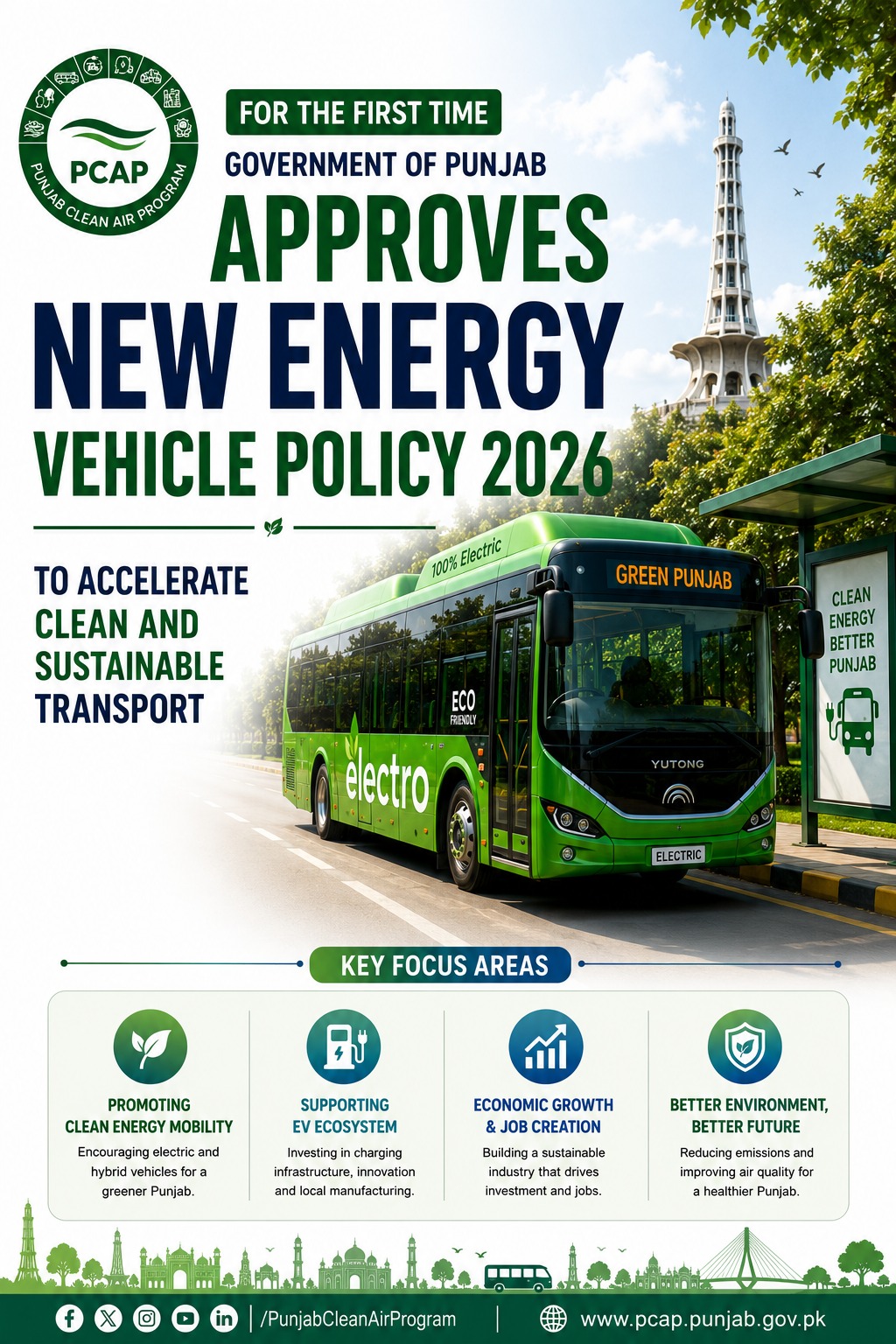
The Government of Punjab has approved the Punjab New Energy Vehicle (NEV) Policy 2026, marking a significant milestone in the province's transition towards clean, sustainable, and environmentally friendly transportation. The policy was approved by the Provincial Cabinet under the Punjab Clean Air Program (PCAP), supported by the World Bank and executed by the Transport & Masstransit Department, Government of the Punjab.
The Punjab NEV Policy 2026 provides a comprehensive roadmap for transitioning towards New Energy Vehicles (NEVs) over the period up to 2035. The policy seeks to reduce greenhouse gas emissions and air pollution, improve public health, strengthen energy security, reduce reliance on imported fossil fuels, and support Pakistan's climate commitments. It also aims to position Punjab as a leading hub for clean mobility and green industrial development.
The policy introduces an integrated framework to accelerate the adoption of electric and other clean energy vehicles across all major transport segments, including two-wheelers, three-wheelers, passenger cars, commercial vehicles, buses, trucks, and government fleets. It establishes a phased transition roadmap supported by measurable implementation milestones and monitoring mechanisms.
To support widespread adoption of NEVs, the policy provides for the development of a province-wide charging and battery-swapping network, including public charging stations, battery-swapping facilities, EV corridors, and renewable energy-powered charging infrastructure to ensure convenient and reliable access for users throughout Punjab.
Environmental sustainability remains at the heart of the policy. It includes provisions for battery recycling, electronic waste management, renewable energy integration, emission reduction, and environmentally responsible disposal practices, ensuring that Punjab's transition to electric mobility contributes to long-term environmental protection and climate resilience.